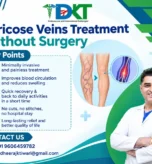
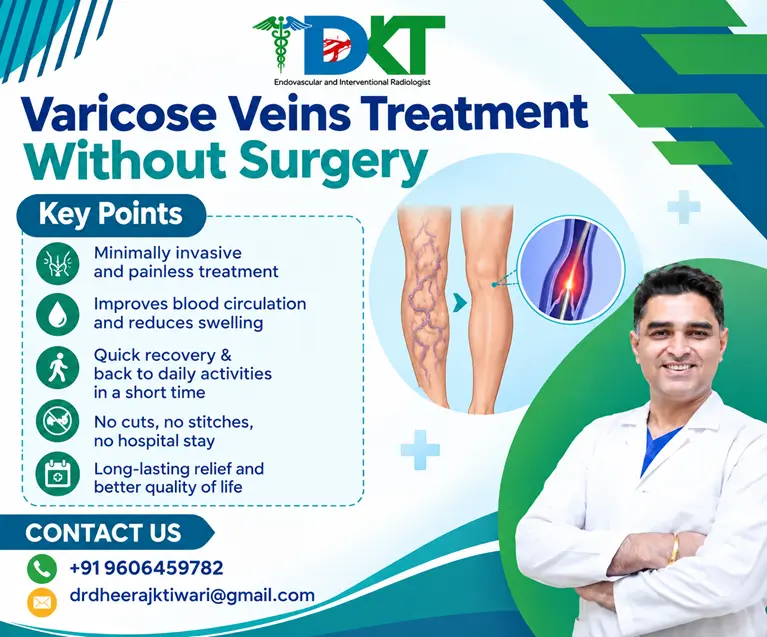
Varicose Veins Treatment Without Surgery in Bangalore has become an important option for people looking for minimally invasive ways to manage symptomatic varicose veins. Varicose veins are enlarged, twisted veins that commonly develop when the valves inside the veins do not work properly, allowing blood to flow backward and pool in the legs.
Symptoms can range from visible veins and leg heaviness to pain, swelling, skin changes and, in advanced cases, venous ulcers. Treatment depends on the severity of venous disease, symptoms, ultrasound findings and the patient’s overall health.
One commonly used minimally invasive option is Varicose Vein Ablation. Endovenous thermal ablation, including radiofrequency and laser techniques, uses ultrasound guidance to close an incompetent vein so that blood can be redirected through healthier veins.
This guide explains Varicose Veins Treatment Without Surgery in Bangalore, including symptoms, causes, diagnosis, treatment options, ablation, benefits, recovery and when specialist evaluation may be appropriate.
Varicose Veins Treatment Without Surgery in Bangalore: Symptoms, Causes & Diagnosis
Varicose veins are usually associated with chronic venous insufficiency, in which valves within the veins fail to prevent backward blood flow. Increased venous pressure can cause superficial veins to become enlarged and prominent.
Symptoms of Varicose Veins
Some people have visible varicose veins without significant symptoms. Others may experience:
- Aching or throbbing in the legs
- Leg heaviness or fatigue
- Swelling around the ankles or legs
- Burning or itching
- Muscle cramps
- Symptoms that become worse after prolonged standing
- Skin discoloration around the ankles
- Changes in the skin texture
- Bleeding from a superficial varicose vein
- Venous ulcers in advanced disease
Symptoms may become more noticeable toward the end of the day or after prolonged standing or physical activity.
Causes and Risk Factors
The underlying problem is often malfunctioning venous valves. When these valves do not close effectively, blood can flow backward, increasing pressure in the veins.
Factors associated with varicose veins and chronic venous insufficiency include:
- Family history of venous disease
- Increasing age
- Pregnancy
- Prolonged standing or sitting
- Obesity
- Previous deep vein thrombosis
- Reduced physical activity
- Previous vein injury
Having a risk factor does not mean that a person will definitely develop varicose veins.
Diagnosis
A specialist generally begins with a medical history and physical examination. The legs may be examined while standing because this can make abnormal veins more visible.
A duplex ultrasound is particularly important when intervention is being considered. It can assess vein structure and blood flow and identify abnormal reflux in superficial veins.
The ultrasound findings help determine whether Varicose Vein Treatment is appropriate and which technique may be suitable.
Varicose Veins Treatment Without Surgery in Bangalore: Varicose Vein Ablation
Not every varicose vein requires an invasive procedure. Mild symptoms may sometimes be managed with lifestyle measures, exercise, leg elevation or compression therapy when appropriate. However, patients with significant symptomatic venous reflux may be evaluated for an interventional treatment.
What Is Varicose Vein Ablation?
Varicose Vein Ablation is a minimally invasive procedure used to close an incompetent vein responsible for abnormal blood reflux.
Two commonly used endothermal techniques are:
- Radiofrequency ablation (RFA): uses radiofrequency energy to heat and close the targeted vein.
- Endovenous laser ablation (EVLA): uses laser energy to heat and close the vein.
Both techniques are performed using ultrasound guidance. NICE describes endothermal ablation as a treatment that closes the affected vein using thermal energy.
Once the treated vein is closed, blood can be redirected through other functioning veins.
How Is the Procedure Performed?
A typical ablation procedure involves several steps:
- The affected vein is identified using ultrasound.
- The skin is cleaned and prepared.
- Local or tumescent anaesthesia is administered as appropriate.
- A small catheter is introduced into the targeted vein.
- Ultrasound is used to guide the catheter into position.
- Radiofrequency or laser energy is delivered along the treatment segment.
- The vein is closed as the catheter is withdrawn.
- The catheter is removed and the access point is covered.
- The patient is observed and given post-procedure instructions.
The Society for Vascular Surgery describes venous ablation as a minimally invasive treatment that can be performed in an office setting, with patients generally able to walk soon after the procedure.
Who May Be Suitable for Ablation?
Suitability depends on symptoms, the anatomy of the affected veins, the presence of reflux on duplex ultrasound and overall clinical circumstances.
NICE recommends endothermal ablation when it is suitable; if it is unsuitable, ultrasound-guided foam sclerotherapy may be considered, followed by surgery when other interventions are unsuitable.
Therefore, Varicose Veins Treatment Without Surgery in Bangalore should be planned after appropriate vascular assessment rather than assuming that one procedure is suitable for everyone.
Varicose Veins Treatment Without Surgery in Bangalore: Benefits, Recovery & Comparison
For appropriately selected patients, Varicose Veins Treatment Without Surgery in Bangalore can provide a minimally invasive approach to symptomatic venous reflux.
Potential Benefits of Varicose Vein Ablation
Potential benefits include:
- Minimally invasive treatment
- Small catheter access rather than conventional vein-stripping incisions
- Treatment under ultrasound guidance
- No need to surgically remove the entire vein
- Generally short recovery compared with traditional stripping
- Ability to walk soon after treatment
- Treatment of the underlying refluxing vein rather than only the visible surface veins
The Society for Vascular Surgery identifies thermal and non-thermal venous ablation among established percutaneous treatments for lower-extremity varicose veins.
Ablation does not guarantee that every visible vein will disappear immediately. Additional treatment, such as sclerotherapy or phlebectomy, may sometimes be recommended for residual varicose tributaries.
Recovery After Ablation
Recovery is generally shorter than with traditional vein-stripping surgery. Patients are usually encouraged to walk after treatment, and many can return to routine activities quickly, depending on their procedure and individual circumstances.
Temporary effects may include:
- Mild soreness
- Bruising
- Tightness along the treated vein
- Local tenderness
- Temporary swelling
Compression stockings may be recommended after thermal ablation depending on the treating specialist’s protocol and individual circumstances. The Society for Vascular Surgery notes that compression may be used for a period after thermal ablation.
Follow-up may include a clinical assessment and ultrasound to confirm closure of the treated vein and check for complications.
Varicose Vein Ablation vs Traditional Surgery
| Feature | Varicose Vein Ablation | Traditional Vein Stripping |
| Approach | Catheter-based | Surgical |
| Incisions | Small catheter access | Surgical incisions |
| Energy | Laser or radiofrequency, depending on technique | Vein is surgically removed |
| Ultrasound guidance | Commonly used | May be used for planning |
| Recovery | Generally shorter | Generally longer |
| Walking after treatment | Usually encouraged | Recovery depends on surgery |
| Suitability | Depends on vein anatomy and reflux | Used when appropriate based on clinical circumstances |
NICE recognizes endothermal ablation, ultrasound-guided foam sclerotherapy and surgery as treatment options, with suitability determined by individual clinical circumstances.
Varicose Veins Treatment Without Surgery in Bangalore With Dr. Dheeraj Tiwari
Patients looking for Varicose Veins Treatment Without Surgery in Bangalore can consult Dr. Dheeraj Tiwari – Interventional Radiologist in Bangalore for evaluation of minimally invasive treatment options.
As an interventional radiologist, Dr. Dheeraj Tiwari can evaluate patients for image-guided vascular procedures based on their symptoms, examination and imaging findings. His relevant services may include varicose vein treatment, minimally invasive venous interventions and image-guided vascular procedures.
The appropriate treatment should be selected after reviewing the duplex ultrasound, the location and extent of venous reflux, symptoms and individual medical factors.
Frequently Asked Questions About Varicose Veins Treatment Without Surgery in Bangalore
1. Can varicose veins be treated without surgery?
Yes. Several minimally invasive treatments are available for appropriately selected patients. Endothermal ablation, including radiofrequency and laser ablation, is one established option.
2. What is Varicose Vein Ablation?
Varicose Vein Ablation is a minimally invasive procedure that closes an incompetent vein responsible for abnormal blood reflux. Radiofrequency and laser are commonly used thermal techniques.
3. Is ablation better than surgery for every patient?
No single treatment is appropriate for everyone. The choice depends on the vein anatomy, reflux pattern, symptoms, previous treatment and individual clinical circumstances. NICE recommends selecting treatment according to suitability.
4. Is duplex ultrasound necessary before Varicose Vein Treatment?
Duplex ultrasound is an important part of assessing venous reflux and planning treatment. It helps identify the veins responsible for abnormal blood flow.
5. How long does recovery take after vein ablation?
Recovery varies between patients, but many people can walk soon after treatment and resume routine activities relatively quickly. Your specialist will provide activity restrictions based on your individual procedure.
6. Will the visible varicose veins disappear immediately?
Not necessarily. The treated vein closes, while the body gradually processes it. Some visible tributary veins may require additional treatment such as sclerotherapy or phlebectomy.
7. Can varicose veins come back after treatment?
Yes. Treatment closes or removes the targeted abnormal veins, but new venous reflux can develop elsewhere over time. Follow-up and management of underlying venous disease remain important.
8. Is Varicose Vein Ablation painful?
Local or tumescent anaesthesia is commonly used for thermal ablation. Patients may experience temporary soreness or tenderness afterward, but the experience varies from person to person.
9. Are compression stockings always required?
Not necessarily. Their use depends on the treatment technique, symptoms and the treating doctor’s recommendations. Compression may be recommended following thermal ablation.
10. When should I see a specialist for varicose veins?
Consider medical evaluation if varicose veins are associated with persistent pain, swelling, skin changes, bleeding, recurrent inflammation or ulcers. These symptoms can indicate more advanced venous disease.
Conclusion
Varicose Veins Treatment Without Surgery in Bangalore can include minimally invasive procedures such as Varicose Vein Ablation, particularly when duplex ultrasound confirms significant venous reflux and the patient is clinically suitable for intervention.
Radiofrequency and laser ablation can close an incompetent superficial vein through a catheter-based approach, while blood continues to circulate through healthier veins. Other treatments, including foam sclerotherapy or surgery, may be appropriate in different clinical situations.
If you have painful or swollen legs, prominent varicose veins, skin changes or persistent heaviness, consult Dr. Dheeraj Tiwari – Interventional Radiologist in Bangalore for a detailed evaluation. Book an appointment to discuss your symptoms, duplex ultrasound findings and suitable Varicose Vein Treatment options, including minimally invasive ablation when appropriate.