
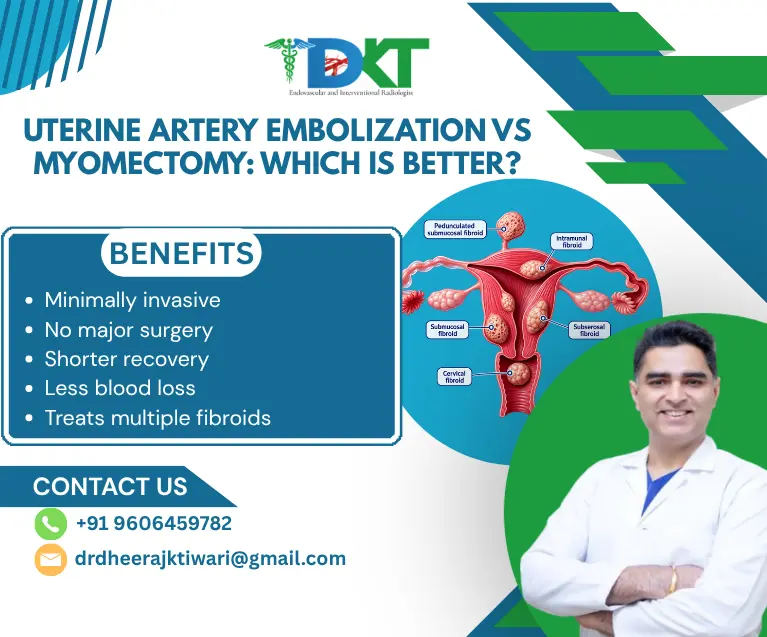
Uterine fibroids are common benign growths that develop in or around the uterus, particularly during the reproductive years. While many fibroids do not cause symptoms, others can lead to heavy menstrual bleeding, pelvic pain, pressure, frequent urination, abdominal fullness, and problems that affect everyday life.
When fibroids become symptomatic, several treatment options may be considered. Two important uterus-preserving approaches are Uterine Artery Embolization (UAE) and myomectomy.
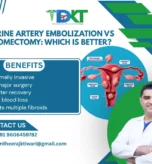
Both treatments can help manage symptomatic uterine fibroids, but they work in very different ways. UAE is a minimally invasive, image-guided procedure that reduces blood flow to fibroids, while myomectomy is a surgical procedure that physically removes the fibroids while preserving the uterus.
So, Uterine Artery Embolization vs Myomectomy: which is better? The answer depends on several factors, including fibroid size, number and location, severity of symptoms, overall health, recovery preferences, and pregnancy or fertility plans.
What Are Uterine Fibroids?
Uterine fibroids, also called leiomyomas or myomas, are non-cancerous growths arising from the muscular tissue of the uterus. They can vary greatly in size, number, and location.
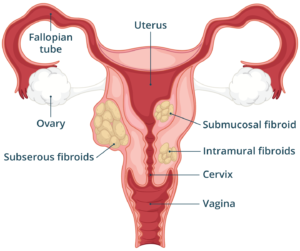
Fibroids are generally classified according to where they develop:
- Submucosal fibroids: Develop toward or within the uterine cavity.
- Intramural fibroids: Develop within the muscular wall of the uterus.
- Subserosal fibroids: Grow toward the outer surface of the uterus.
Some women may have one fibroid, while others may have multiple fibroids of different sizes and locations.
Common Symptoms of Uterine Fibroids
Fibroids may be completely asymptomatic or may cause symptoms such as:
- Heavy or prolonged menstrual bleeding
- Pelvic pain or cramping
- Pelvic pressure or fullness
Uterine Fibroids
- Abdominal enlargement
- Frequent urination
- Bowel or bladder pressure
- Pain during intercourse
- Fatigue associated with heavy blood loss
- Problems affecting quality of life
The symptoms often depend on the size, number, and location of the fibroids.
What Is Uterine Artery Embolization?
Uterine Artery Embolization (UAE), also commonly referred to as Uterine Fibroid Embolization (UFE), is a minimally invasive treatment for symptomatic uterine fibroids.
Instead of surgically removing the fibroids, UAE works by reducing their blood supply.
During the procedure, an interventional radiologist guides a thin catheter through a blood vessel toward the uterine arteries. Tiny embolic particles are then delivered through the catheter into the arteries supplying the fibroids.
This reduces blood flow to the fibroids, causing them to shrink gradually and helping relieve symptoms.
How Is Uterine Artery Embolization Performed?
The procedure generally involves:
- Pre-procedure evaluation: Imaging such as ultrasound or MRI may be performed to assess the fibroids.
- Vascular access: A small access point is made in a blood vessel, commonly through the groin.
- Catheter guidance: A thin catheter is carefully guided toward the uterine arteries using imaging.
- Embolization: Small embolic particles are delivered to reduce blood flow to the fibroids.
- Recovery: The catheter is removed and the patient is monitored following the procedure.
UAE is minimally invasive and does not require surgical removal of the uterus.
What Is Myomectomy?
Myomectomy is a surgical treatment in which the fibroids are physically removed while leaving the uterus in place.
Depending on the size and location of the fibroids, myomectomy may be performed using different surgical approaches, including:
- Open abdominal myomectomy
- Laparoscopic myomectomy
- Hysteroscopic myomectomy
- Other minimally invasive or assisted surgical techniques
The appropriate surgical approach depends on the individual patient’s fibroid characteristics and overall health.
Uterine Artery Embolization vs Myomectomy: Key Difference
The biggest difference between UAE and myomectomy is how the fibroids are treated.
| Feature | Uterine Artery Embolization | Myomectomy |
| Treatment type | Minimally invasive | Surgical |
| How it works | Reduces blood supply to fibroids | Physically removes fibroids |
| Uterus preserved | Yes | Yes |
| Abdominal incision | No conventional surgical incision | Depends on surgical approach |
| Multiple fibroids | Can treat multiple fibroids | May remove selected fibroids |
| Recovery | Generally shorter than major surgery | Usually longer than UAE |
| Hospital stay | May be shorter | Can be longer depending on surgery |
| Re-intervention | Higher in some studies | Lower in the cited meta-analysis |
| Pregnancy plans | Requires individual counseling | Often considered when uterine preservation and future pregnancy are priorities |
The choice should be individualized rather than based on a single factor.
UAE vs Myomectomy: What Does Research Show?
A systematic review and meta-analysis comparing UAE and myomectomy included nine studies involving approximately 196,595 patients.
The analysis examined important outcomes including re-intervention, hospital stay, and complications.
Re-Intervention Rates
One of the most important findings was that UAE was associated with a higher rate of re-intervention compared with myomectomy.
The pooled analysis reported a risk ratio of approximately 2.16 for re-intervention with UAE compared with myomectomy.
This means that, in the studies included in the analysis, women undergoing UAE were more likely to require another procedure during the respective follow-up periods.
However, treatment decisions should not be based on re-intervention alone. The minimally invasive nature of UAE, recovery considerations, uterine preservation, and individual treatment goals are also important.
Hospital Stay
The analysis found that UAE was associated with a numerically shorter hospital stay compared with myomectomy.
The pooled mean difference was approximately −1.12 days, although this difference was not statistically significant in the overall analysis.
This finding is consistent with the minimally invasive nature of UAE and its potential for a relatively shorter recovery compared with major abdominal surgery.
Major Complications
The analysis did not demonstrate a statistically significant difference in major complications between UAE and myomectomy.
The pooled results therefore do not establish one procedure as definitively safer than the other for major complications.
Minor Complications
The analysis also did not demonstrate a statistically significant difference in minor complications.
This highlights why patients should discuss the potential benefits, limitations, and risks of both treatment options with their healthcare team.
Advantages of Uterine Artery Embolization
For appropriately selected patients, Uterine Artery Embolization may offer several advantages.
1. Minimally Invasive
UAE is performed through a small vascular access point rather than through conventional abdominal surgery.
2. Uterus Preservation
The uterus remains in place, which can be important for women who wish to preserve their uterus.
3. Can Treat Multiple Fibroids
Because UAE targets the blood supply to fibroids, it can be considered for patients with multiple symptomatic fibroids.
4. No Conventional Abdominal Surgical Incision
UAE does not require the type of abdominal incision used for open myomectomy.
5. Potentially Faster Recovery
Because UAE is minimally invasive, recovery may be shorter than that associated with major abdominal surgery.
6. May Reduce Fibroid-Related Symptoms
Reducing blood flow to the fibroids can cause them to shrink and may improve symptoms such as heavy menstrual bleeding, pelvic pressure, and pain.
Advantages of Myomectomy
Myomectomy also has important advantages and remains an established treatment for symptomatic uterine fibroids.
1. Fibroids Are Physically Removed
Unlike UAE, which causes fibroids to shrink over time, myomectomy directly removes the targeted fibroids.
2. Uterus Is Preserved
The uterus remains in place following myomectomy.
3. Can Be Considered for Certain Fertility Goals
For women who are planning pregnancy, myomectomy may be considered depending on the size and location of the fibroids and their effect on the uterine cavity.
A fertility-focused decision should be made with appropriate gynecological evaluation.
4. Lower Re-Intervention Rate in the Cited Analysis
The meta-analysis found a significantly lower re-intervention rate following myomectomy compared with UAE.
Which Is Better: UAE or Myomectomy?
There is no single treatment that is better for every woman.
The answer to Uterine Artery Embolization vs Myomectomy depends on the patient’s individual situation.
UAE may be considered when:
- A minimally invasive treatment is preferred
- The patient wants to preserve the uterus
- Multiple fibroids are present
- Fibroid-related bleeding or pressure symptoms are significant
- Avoiding conventional surgery is an important priority
- The patient’s imaging and clinical evaluation indicate that UAE is appropriate
Myomectomy may be considered when:
- Removing specific fibroids is preferred
- Fibroid location makes surgical removal appropriate
- Future pregnancy is an important consideration
- The fibroid is significantly affecting the uterine cavity
- A lower likelihood of re-intervention is an important priority
- The patient’s gynecologist considers surgery the more suitable approach
UAE vs Myomectomy for Fertility
Fertility is one of the most important considerations when choosing a fibroid treatment.
Although both UAE and myomectomy can preserve the uterus, uterus preservation does not automatically mean that fertility outcomes are identical.
Women who are planning pregnancy should receive individualized counseling before choosing UAE or myomectomy.
The decision may depend on:
- Age
- Number of fibroids
- Fibroid size
- Fibroid location
- Whether the uterine cavity is affected
- Previous fertility history
- Ovarian reserve
- Other reproductive factors
- Overall health
A woman planning pregnancy should discuss both options with her gynecologist and, when appropriate, an interventional radiologist before treatment.
Recovery: UAE vs Myomectomy
Recovery can be an important factor for women balancing treatment with work, family, and daily responsibilities.
UAE is minimally invasive and may involve a shorter hospital stay and faster return to routine activities than major surgery. Some women experience pelvic cramping, fatigue, nausea, or discomfort during the early recovery period.
Myomectomy involves surgical removal of fibroids, and recovery varies depending on whether the procedure is hysteroscopic, laparoscopic, or open. Open surgery generally requires more recovery time than minimally invasive surgical approaches.
Your doctor can provide a more accurate recovery estimate based on the specific procedure recommended.
Risks of Uterine Artery Embolization
Like any medical procedure, UAE has potential risks and side effects.
These can include:
- Pelvic pain or cramping
- Nausea
- Fatigue
- Bruising or hematoma at the access site
- Infection
- Contrast-related reactions
- Menstrual changes
- Vascular complications
- Incomplete symptom improvement
- Need for additional treatment
A condition commonly discussed after embolization is post-embolization syndrome, which may involve pain, nausea, fatigue, and mild fever during the early recovery period.
Risks of Myomectomy
Myomectomy is a surgical procedure and may involve risks such as:
- Bleeding
- Infection
- Anesthesia-related complications
- Scar formation
- Adhesions
- Injury to nearby organs
- Recovery-related discomfort
- Recurrence or development of additional fibroids
- Possible need for further treatment
The risks vary depending on the surgical technique, number and size of fibroids, and the patient’s overall health.
How Is the Right Treatment Chosen?
Before recommending UAE or myomectomy, the specialist may assess the fibroids using ultrasound and, when necessary, MRI.
Important factors include:
Fibroid Size
Large fibroids may require a different treatment approach from smaller fibroids.
Fibroid Location
Whether a fibroid is submucosal, intramural, or subserosal can influence treatment planning.
Number of Fibroids
Multiple fibroids may affect the choice of treatment.
Symptoms
Heavy menstrual bleeding, pain, pressure, and urinary or bowel symptoms should be considered.
Fertility Plans
Women planning pregnancy should discuss fertility implications before choosing treatment.
Overall Health
Medical conditions, previous surgeries, medications, and other health factors can influence treatment selection.
Patient Preference
The choice between minimally invasive treatment and surgery should also reflect the patient’s priorities after understanding the benefits and limitations of each option.
Is Uterine Artery Embolization a Non-Surgical Treatment?
Yes. UAE is considered a minimally invasive, non-surgical treatment because it is performed using a catheter inserted through a blood vessel rather than surgically opening the abdomen to remove the fibroids.
However, “non-surgical” does not mean risk-free. UAE is still a medical procedure and should be performed after appropriate evaluation by an experienced specialist.
Does the UAE Remove Fibroids?
No. UAE does not physically remove the fibroids.
Instead, it reduces the blood supply to the fibroids. With reduced blood flow, the fibroids can gradually shrink, which may improve symptoms.
This differs from myomectomy, where the fibroids are directly removed during surgery.
Can Multiple Fibroids Be Treated With UAE?
UAE can be considered for women with multiple symptomatic fibroids. Since the procedure targets the arteries supplying the fibroids, several fibroids may be treated during the same procedure.
However, suitability depends on the individual anatomy, fibroid characteristics, blood supply, symptoms, and other medical factors.
Uterine Artery Embolization vs Myomectomy: Quick Comparison
| Factor | UAE | Myomectomy |
| Minimally invasive | Yes | Depends on approach |
| Fibroids physically removed | No | Yes |
| Uterus preserved | Yes | Yes |
| Multiple fibroids | Can be treated | May be treated individually |
| Conventional abdominal incision | No | Open myomectomy requires one |
| Recovery | Generally shorter than major surgery | Depends on surgical technique |
| Re-intervention | Higher in cited meta-analysis | Lower in cited meta-analysis |
| Fertility counseling | Important | Important |
| Suitable for everyone | No | No |
Frequently Asked Questions
Is the UAE better than myomectomy?
Neither procedure is universally better. UAE may be preferable for women seeking a minimally invasive approach, while myomectomy may be preferable in situations where direct removal of fibroids is important, particularly when specific fertility considerations favor surgery.
Which has a lower re-intervention rate?
The cited meta-analysis found that myomectomy had a significantly lower re-intervention rate than UAE.
Which has a shorter recovery?
UAE generally involves less invasive treatment and may allow a faster recovery than major abdominal myomectomy. However, recovery varies between patients and depends on the type of myomectomy performed.
Can UAE preserve the uterus?
Yes. UAE is designed to treat fibroids while preserving the uterus.
Can myomectomy preserve fertility?
Myomectomy preserves the uterus and may be considered for women who wish to become pregnant, depending on their individual fibroid characteristics and reproductive circumstances.
Can UAE be performed for multiple fibroids?
Yes, UAE can treat multiple symptomatic fibroids in appropriately selected patients.
Does the UAE permanently cure fibroids?
UAE treats existing fibroids by reducing their blood supply and causing them to shrink. However, new fibroids or fibroid-related symptoms may develop later, and some patients may require additional treatment.
How do I know whether UAE or myomectomy is right for me?
A specialist evaluation is necessary. Your doctor may consider your symptoms, ultrasound or MRI findings, fibroid size and location, number of fibroids, medical history, and pregnancy plans before recommending a treatment.
About Dr. Dheeraj Tiwari
Dr. Dheeraj Kumar Tiwari is a Senior Consultant and Head of Interventional Radiology at Narayana Health City in Bengaluru. His practice focuses on minimally invasive, image-guided procedures, including Uterine Fibroid Treatment and Uterine Artery Embolization, along with other interventional radiology procedures.
Women considering Uterine Artery Embolization can undergo an individualized evaluation to determine whether UAE is appropriate based on their symptoms, imaging findings, fibroid characteristics, medical history, and treatment goals.
Conclusion
Uterine Artery Embolization vs Myomectomy is not a simple choice between better or worse treatment. Both can effectively manage symptomatic uterine fibroids.
Research shows that myomectomy has a lower re-intervention rate, while UAE may offer a shorter hospital stay and a minimally invasive, uterus-preserving approach. The best uterine fibroid treatment depends on fibroid size, number, location, symptoms, overall health, fertility plans, and personal preferences.
Book an Appointment With Dr. Dheeraj Tiwari
If you have symptomatic uterine fibroids and are considering Uterine Artery Embolization vs Myomectomy, consult an experienced specialist to understand which option may be appropriate for your condition.
Schedule a consultation with Dr. Dheeraj Tiwari in Bangalore to discuss whether UFE Treatment may be suitable for you.