
Thyroid nodules are common, and while many are harmless, some can become large enough to cause pressure, swallowing difficulty, neck discomfort, or visible swelling. Traditionally, treatment options have included observation, medication in selected cases, surgery, radioactive iodine, and minimally invasive ablation techniques.
A newer interventional radiology approach called thyroid artery embolization (TAE) is being studied and used in selected patients with benign thyroid disease. The technique works by reducing blood flow to targeted thyroid tissue, with the aim of reducing its size and associated symptoms. Current evidence suggests that thyroid artery embolization is an emerging treatment, rather than a universally established replacement for thyroid surgery or thyroid ablation.
This Thyroid Nodule Embolization Gudie explains who may benefit, how the procedure is performed, its potential advantages, recovery, and how it compares with other thyroid treatments.
Understanding Thyroid Nodules and When Treatment May Be Needed
What is a thyroid nodule?
A thyroid nodule is a lump or abnormal area of tissue within the thyroid gland. Nodules may be solid, cystic, or a combination of both. Most thyroid nodules are benign, but evaluation is important to determine whether a nodule requires monitoring or treatment.
Some nodules remain stable for years without causing problems. Others may gradually enlarge and produce pressure symptoms or cosmetic concerns.
The goal of Thyroid Nodule Treatment is not simply to remove every nodule. Instead, treatment is selected according to the nodule’s size, ultrasound characteristics, symptoms, thyroid function, cytology, growth pattern, and the patient’s overall health.
Symptoms of thyroid nodules
Many thyroid nodules cause no symptoms. When a nodule becomes large or presses against surrounding structures, symptoms may include:
- A visible lump or swelling in the neck
- Neck pressure or discomfort
- Difficulty swallowing
- A feeling of something stuck in the throat
- Difficulty breathing in large compressive nodules
- Hoarseness or voice changes
- Neck fullness
- Cosmetic concerns
- Symptoms associated with an overactive thyroid in some patients
A rapidly enlarging thyroid swelling, persistent hoarseness, or difficulty breathing or swallowing should be medically evaluated promptly.
Causes and risk factors
Thyroid nodules can develop for several reasons, including:
- Benign thyroid tissue overgrowth
- Multinodular goiter
- Thyroid cysts
- Thyroiditis
- Iodine-related factors
- Certain genetic or environmental factors
- Thyroid cancer in a minority of cases
Age, previous radiation exposure to the neck, family history of thyroid cancer, and certain thyroid disorders can influence risk.
Diagnosis before treatment
A careful diagnosis is essential before considering Thyroid Nodule Treatment Without Surgery or any other intervention.
Doctors commonly use:
- Thyroid ultrasound – assesses size, composition, margins, vascularity, and other characteristics.
- Thyroid function tests – including TSH and, when appropriate, free T4 and T3.
- Fine-needle aspiration (FNA) – may be recommended when ultrasound findings and nodule size meet criteria for biopsy.
- Medical history and physical examination – help determine symptoms and risk factors.
- Additional imaging or molecular testing – may be considered in selected cases.
Importantly, embolization should not be used to avoid appropriate cancer evaluation. A nodule suspected of being malignant requires an appropriate diagnostic and treatment pathway.
Thyroid Nodule Embolization Gudie should therefore begin with proper diagnosis rather than assuming every thyroid nodule is suitable for embolization.
How Thyroid Nodule Embolization Works
What is thyroid artery embolization?
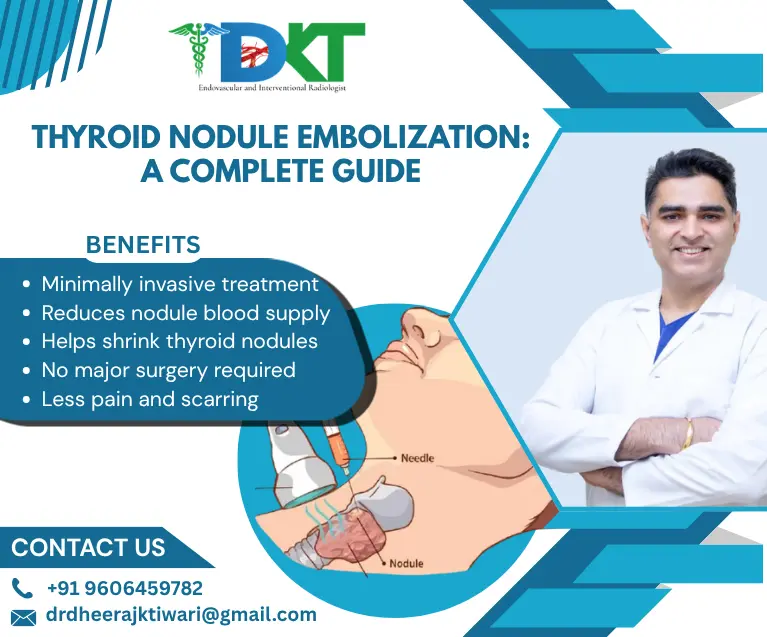
Thyroid artery embolization is an image-guided interventional procedure designed to reduce blood flow through selected thyroid arteries. Small embolic materials are delivered through a catheter to targeted vessels supplying the thyroid tissue.
By reducing blood supply, the treated thyroid tissue can gradually shrink. Research has reported reductions in thyroid or nodule volume following embolization, although the available evidence remains limited compared with more established thyroid treatments.
A 2026 review describes thyroid artery embolization as an emerging minimally invasive option for benign thyroid hyperplasia, particularly in selected patients who are poor surgical candidates or who decline surgery.
Who may be considered?
Potential candidates may include carefully selected patients with:
- Large symptomatic benign thyroid nodules
- Multinodular goiter
- Benign thyroid enlargement causing pressure symptoms
- Selected functional thyroid disease
- Significant surgical concerns
- A preference for minimally invasive treatment after appropriate medical evaluation
Not every patient is a candidate. The decision depends on thyroid anatomy, blood supply, diagnosis, thyroid function, nodule characteristics, previous treatments, and the expertise of the treating team.
Treatment and procedure
The exact technique can vary according to the patient’s anatomy and the interventional radiologist’s approach. Generally, the process includes:
- Pre-procedure assessment:
The doctor reviews ultrasound, laboratory results, biopsy findings where indicated, and medical history. - Vascular access:
A small catheter is introduced through an appropriate blood vessel, which may include a radial or femoral approach depending on the case. - Imaging guidance:
Fluoroscopy and angiography help identify the arteries supplying the thyroid. - Selective catheterization:
The interventional radiologist carefully advances the catheter toward the target thyroid arteries. - Embolization:
Small embolic particles or another appropriate embolic agent are delivered to reduce blood flow to the targeted tissue. - Completion imaging:
The physician confirms the intended reduction in blood supply while attempting to avoid non-target embolization. - Observation:
The patient is monitored following the procedure before discharge or overnight observation, depending on the clinical situation.
Recent research has also investigated direct ultrasound-guided thyroid artery embolization followed by ablation in selected benign thyroid nodules, showing how treatment strategies continue to evolve.
Potential benefits
One of the main attractions of this approach is that it may offer a minimally invasive option for selected patients.
Potential benefits include:
- No conventional neck incision
- Reduced surgical trauma
- Potential reduction in thyroid or nodule volume
- Improvement in pressure-related symptoms in suitable patients
- Potentially shorter recovery than conventional surgery
- Image-guided and targeted treatment
- An option for some patients who are unsuitable for major surgery
However, benefits vary from patient to patient. Embolization is not automatically safer or more effective than every other treatment option.
The available research is encouraging, but studies remain relatively limited. A meta-analysis involving 10 studies and 347 patients reported significant reductions in nodule volume, while also emphasizing that published evidence for thyroid nodules remains limited.
Risks and limitations
As with any medical procedure, thyroid artery embolization has potential risks. These can include pain or discomfort, swelling, temporary inflammatory symptoms, bleeding or bruising at the access site, infection, thyroid-function changes, and unintended embolization.
The anatomy of the thyroid is complex, so careful patient selection and experienced interventional expertise are important.
Because this is an evolving technique, patients should discuss the expected benefits, alternatives, uncertainties, and follow-up requirements with their treating specialist.
This Thyroid Nodule Embolization Gudie should be used for education and not as a substitute for individualized medical advice.
Recovery, Comparison and Expert Care in Bangalore
Recovery after embolization
Recovery depends on the extent of treatment and the patient’s general health. Mild neck discomfort or tenderness can occur after the procedure. Some patients may return to routine activities relatively quickly, while others may need additional rest.
Follow-up generally involves clinical assessment and, when appropriate, ultrasound or thyroid-function testing. The purpose is to evaluate symptom improvement, thyroid function, and changes in nodule or gland volume.
Patients should follow their doctor’s instructions regarding medication, physical activity, wound care, and follow-up appointments.
Embolization vs other thyroid treatments
| Treatment | Typical approach | Main consideration |
| Observation | Regular monitoring | Suitable for many asymptomatic benign nodules |
| Surgery | Removal of part or all of the thyroid | Established option for selected nodules and cancers |
| Radiofrequency ablation | Heat-based destruction of nodule tissue | Established minimally invasive option for selected benign nodules |
| Thyroid artery embolization | Reduces arterial blood flow | Emerging option requiring careful patient selection |
| Radioactive iodine | Uses radioactive iodine | Mainly used for selected hyperfunctioning thyroid conditions |
The best Thyroid Nodule Treatment depends on the diagnosis rather than the desire to avoid surgery alone.
For some benign nodules, thermal ablation may be more established. For others, surgery may remain the most appropriate option. Thyroid artery embolization may be considered in selected circumstances, particularly when reducing thyroid volume is an important treatment objective.
About Dr. Dheeraj Tiwari
Dr. Dheeraj Kumar Tiwari is a Senior Consultant and Head of Interventional Radiology at Narayana Health City in Bengaluru, according to his official professional website. His listed qualifications include MBBS, DNB in Radiology, and fellowship training in Interventional Radiology.
His practice focuses on minimally invasive, image-guided procedures. Services listed on his website include Thyroid Artery Embolization, Thyroid Ablation, Uterine Fibroid Treatment, Prostatic Artery Embolization, Varicocele treatment, Varicose Vein treatment, vacuum-assisted breast biopsy, pain management, dialysis access interventions, and other interventional radiology procedures.
For patients considering Thyroid Nodule Treatment Without Surgery, consultation with an experienced interventional radiologist can help determine whether an image-guided approach is appropriate or whether another treatment would provide a better outcome.
Frequently Asked Questions
1. Is thyroid nodule embolization a non-surgical treatment?
Yes. Thyroid artery embolization is performed through vascular access rather than a conventional surgical neck incision. However, it is an emerging treatment and is not appropriate for every thyroid nodule.
2. Can embolization completely remove a thyroid nodule?
Not necessarily. The objective is generally to reduce blood flow and encourage shrinkage of targeted thyroid tissue. The amount of volume reduction varies between patients.
3. Is thyroid artery embolization suitable for cancerous nodules?
It should not be considered a substitute for appropriate cancer treatment. A suspicious thyroid nodule needs proper diagnostic evaluation, usually including imaging and biopsy when indicated.
4. How is thyroid nodule embolization different from RFA?
RFA uses heat to destroy targeted nodule tissue. Embolization works by reducing the blood supply to targeted thyroid tissue. The appropriate technique depends on the nodule and the patient’s clinical circumstances.
5. Can thyroid artery embolization help large thyroid nodules?
Potentially, yes. Research has investigated embolization in large symptomatic benign nodules and multinodular goiter, with reported reductions in thyroid or nodule volume.
6. How long does recovery take?
Recovery varies. Many minimally invasive procedures allow relatively rapid return to normal activities, but the exact timeline should be provided by the treating specialist.
7. Will thyroid function change after embolization?
It can. Thyroid function should be assessed before and after treatment when clinically appropriate. Changes depend on the underlying thyroid condition and amount of tissue treated.
8. Is embolization better than thyroid surgery?
There is no single best treatment for everyone. Surgery remains an established treatment for many thyroid conditions, while embolization is an emerging minimally invasive approach for selected patients.
9. How do I know whether I am a candidate?
A specialist needs to review your symptoms, thyroid ultrasound, thyroid-function tests, biopsy results where required, medical history, and vascular anatomy before recommending treatment.
Conclusion
Thyroid Nodule Embolization Gudie is an important topic for patients exploring minimally invasive approaches to benign thyroid disease. Thyroid artery embolization aims to reduce blood flow to targeted thyroid tissue and may help reduce gland or nodule volume in carefully selected patients.
Current research is promising, but embolization remains an evolving technique. Proper diagnosis, assessment of malignancy risk, consideration of established alternatives, and treatment by an appropriately trained specialist are essential.
If you have a large or symptomatic thyroid nodule and want to understand your treatment options, do not choose a procedure based only on the promise of avoiding surgery. A personalized evaluation can help determine whether embolization, thyroid ablation, surgery, observation, or another approach is most appropriate.
Thinking about Thyroid Nodule Treatment Without Surgery in Bangalore? Book a consultation with Dr. Dheeraj Tiwari, Interventional Radiologist in Bangalore, to discuss your thyroid nodule, available minimally invasive options, and whether thyroid artery embolization or thyroid ablation may be suitable for your condition.