

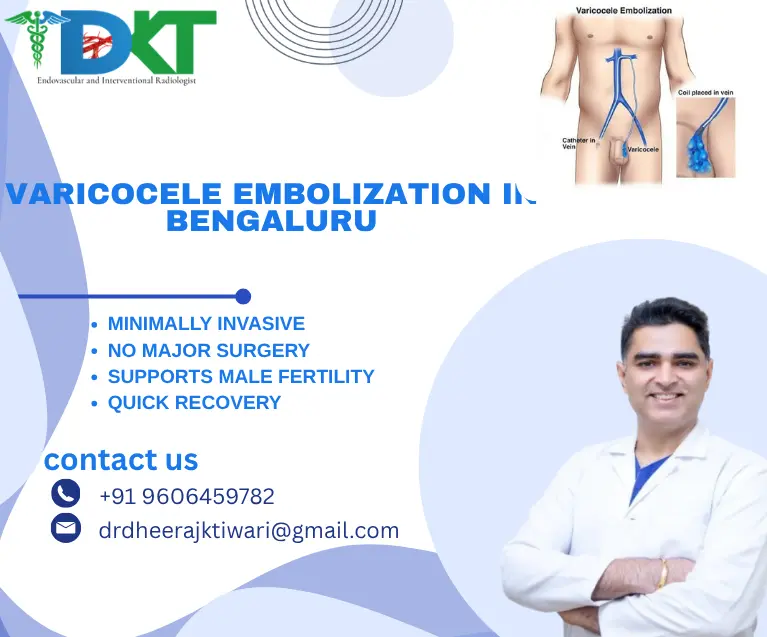
Varicocele is a condition in which veins inside the scrotum become enlarged due to abnormal blood flow. It may cause discomfort, heaviness, swelling, or fertility-related concerns in some men. While many varicoceles do not require treatment, others may benefit from medical assessment and appropriate intervention.
Varicocele Embolization in Bengaluru is a minimally invasive, image-guided procedure used to treat selected cases of varicocele. It involves inserting a thin catheter into a vein and blocking the abnormal veins responsible for the condition. This approach may be suitable for patients seeking an alternative to conventional surgery, depending on their medical history and clinical findings.
For individuals exploring Varicocele Treatment, understanding the symptoms, causes, diagnostic process, available treatment options, and recovery expectations can help them make informed decisions.
Patients seeking evaluation in Bengaluru can consult an appropriately qualified specialist. Dr. Dheeraj Tiwari is an interventional radiologist associated with care in Bengaluru. Patients should confirm his current availability and suitability for their specific condition before booking an appointment.
What Is Varicocele? Symptoms, Causes, and Diagnosis
What is a varicocele?
A varicocele is an enlargement of the veins within the scrotum, the pouch of skin that holds the testicles. These veins help carry blood away from the testicles. When the valves inside the veins do not function effectively, blood may collect in them, causing the veins to enlarge.
Varicoceles commonly develop on the left side, although they can affect both sides. The condition may be discovered during a routine examination or while investigating fertility concerns.
Not every varicocele requires intervention. The decision to pursue Varicocele Treatment depends on symptoms, physical examination findings, testicular development, fertility goals, and other individual factors.
Common symptoms of varicocele
Some men experience no symptoms, while others may notice:
- A dull ache or discomfort in the scrotum.
- A feeling of heaviness, particularly after prolonged standing.
- Pain that increases during physical activity and improves when lying down.
- Enlarged or twisted veins that may feel like a bundle of cords.
- Differences in testicular size in some cases.
- Fertility difficulties associated with impaired sperm production or quality.
Persistent pain, a newly developed lump, or sudden scrotal discomfort should not automatically be attributed to a varicocele. These symptoms require appropriate medical assessment. Sudden, severe testicular pain needs urgent medical attention.
What causes varicocele?
Varicoceles develop when blood does not drain efficiently through the veins around the testicles. Faulty venous valves and differences in venous anatomy can contribute to this problem.
Factors associated with varicocele include:
- Ineffective valves within the testicular veins.
- Increased pressure within the affected veins.
- Anatomical differences in the drainage of the left and right testicular veins.
A varicocele is not generally caused by poor hygiene, sexual activity, or a lack of exercise. In most cases, there is no single preventable cause.
How is varicocele diagnosed?
Diagnosis usually begins with a medical history and physical examination. The clinician may examine the scrotum while the patient is standing and lying down, sometimes asking the patient to perform a manoeuvre that increases abdominal pressure.
Depending on the findings, investigations may include:
- Scrotal ultrasound with Doppler: Evaluates the veins, blood flow, and testicular structure.
- Semen analysis: Assesses sperm concentration, movement, and other relevant parameters when fertility is a concern.
- Hormonal tests: May be recommended when symptoms or fertility findings indicate a need for further evaluation.
For patients considering Varicocele Embolization in Bengaluru, these assessments help determine whether treatment is appropriate and whether other conditions need to be excluded.
What Is Varicocele Embolization? Procedure and Potential Benefits
How does varicocele embolization work?
Varicocele Embolization is a minimally invasive procedure performed by a suitably trained interventional radiologist using imaging guidance. Instead of surgically tying off the affected veins through an incision, the specialist accesses a vein through a small puncture, commonly in the groin or neck.
A thin catheter is guided through the blood vessels to the abnormal testicular veins. Once the target veins are identified, the specialist uses embolic materials, such as tiny coils or a suitable embolic agent, to block the abnormal blood flow.
The body then redirects blood through other healthy veins. The access site is covered with a small dressing after the catheter is removed.
What happens during the procedure?
The precise technique depends on the patient’s anatomy, the equipment available, and the specialist’s assessment. The procedure generally involves the following stages:
- Pre-procedure assessment: The specialist reviews symptoms, ultrasound findings, medical history, allergies, and relevant test results.
- Preparation: The patient receives instructions about fasting, medications, and other precautions when required.
- Venous access: The skin is cleaned and local anaesthesia is used at the access site. Additional medication may be provided when appropriate.
- Image-guided catheter placement: Fluoroscopy and contrast material may be used to identify the affected veins.
- Embolization: Coils or other suitable materials are placed to block the abnormal veins.
- Completion and observation: The catheter is removed, the access site is dressed, and the patient is monitored before discharge when clinically appropriate.
The procedure commonly takes around 30–90 minutes, although the duration can vary with anatomy and procedural complexity. The treating team will explain the expected process for the individual patient.
Potential benefits of varicocele embolization
For appropriately selected patients, potential benefits include:
- No large surgical incision: The procedure generally uses a small puncture to access a vein.
- Shorter initial recovery: Many patients return to light daily activities relatively quickly.
- Usually performed without general anaesthesia: Local anaesthesia is commonly used, although sedation or other arrangements may be needed.
- An alternative to surgical treatment: Embolization may be considered when a patient prefers a minimally invasive approach or has a recurrent varicocele after surgery.
- Treatment of the affected veins: The procedure targets abnormal venous drainage rather than removing or directly operating on the testicle.
These benefits are not guaranteed for every patient. Embolization may be technically unsuccessful or may not relieve symptoms. Potential risks include access-site bruising, contrast reactions, radiation exposure, vein injury, coil migration, persistent symptoms, and recurrence.
Who may be suitable for this procedure?
Varicocele Treatment may be considered for men with persistent discomfort, selected fertility-related concerns, or other clinically significant findings. Embolization may be an option when the varicocele is confirmed and its anatomy is suitable for catheter-based treatment.
However, not every varicocele should be treated. For example, an ultrasound finding alone does not necessarily justify intervention in someone without relevant symptoms or other clinical indications.
The decision should be made after reviewing the patient’s examination, imaging, fertility goals, and overall health.
Varicocele Treatment Options: Embolization vs Surgery and Recovery
Varicocele embolization vs surgical treatment
Both embolization and surgery aim to stop abnormal blood flow through the affected veins. They differ in how the veins are accessed and treated.
| Feature | Varicocele embolization | Varicocele surgery |
| Approach | Catheter inserted through a small venous puncture | Small incision to access and treat affected veins |
| Anaesthesia | Usually local anaesthesia, sometimes with sedation | Depends on technique; commonly general or regional anaesthesia |
| Hospital stay | Often performed as a day procedure | Often day surgery, depending on the technique and patient |
| Recovery | Many patients resume light activities within a few days | Recovery varies; strenuous activities may need to be avoided longer |
| Recurrence or persistence | Possible | Possible |
| Suitability | Depends on venous anatomy and clinical findings | Depends on the varicocele, patient factors, and surgical assessment |
Microsurgical varicocelectomy is one established surgical option. Neither approach is universally better for every patient. Outcomes depend on the technique, the clinician’s experience, the patient’s anatomy, and the reason for treatment.
When choosing Varicocele Treatment in Bengaluru, patients should discuss the expected benefits, risks, likelihood of symptom improvement, recurrence, and fertility-related outcomes with their treating specialist.
What is recovery like after embolization?
Recovery following Varicocele Embolization is often relatively straightforward, but individual experiences vary.
During the first 24 hours: Mild soreness or bruising at the puncture site may occur. Follow the discharge instructions, rest as advised, and avoid driving if sedating medication was used.
Over the next few days: Many patients can return to desk-based work and light activities when comfortable. Follow the treating team’s advice about lifting, exercise, and sexual activity.
Over the following weeks: Discomfort may gradually improve. The enlarged veins may not disappear immediately, and improvement in symptoms can take time.
Follow-up assessment: The clinician may recommend a review to assess symptoms and determine whether further imaging is necessary. Patients undergoing treatment because of fertility concerns may need repeat semen analysis at an appropriate interval.
Contact the treating team if pain is worsening, swelling is increasing, or the puncture site shows signs of infection. Sudden severe testicular pain, significant bleeding, or other serious symptoms require urgent medical assessment.
Factors that influence treatment decisions
The appropriate treatment and its expected results depend on several factors, including:
- The severity and duration of symptoms.
- Findings on physical examination and Doppler ultrasound.
- Whether fertility is a treatment goal.
- The size and location of the affected veins.
- Previous varicocele surgery or embolization.
- Other medical conditions, medications, and procedural risks.
- The patient’s preferences after discussing the alternatives.
There is no single treatment plan suitable for everyone. A consultation is necessary to determine the most appropriate approach.
Frequently Asked Questions About Varicocele Embolization in Bengaluru
1. Is varicocele embolization a major surgery?
No. Embolization is a minimally invasive, image-guided procedure performed through a small venous puncture rather than a conventional surgical incision. It still carries procedural risks and requires assessment by a qualified specialist.
2. Is varicocele embolization painful?
Local anaesthesia helps minimise discomfort at the access site. Some patients experience pressure during the procedure or mild soreness afterwards. The level of discomfort varies, and the treating team can explain how it will be managed.
3. How long does recovery take after varicocele embolization?
Many patients resume light activities within a few days. The time needed to return to strenuous exercise or heavy lifting depends on recovery and the treating specialist’s instructions.
4. Can varicocele embolization improve fertility?
It may improve semen parameters in some appropriately selected men, but improvement is not guaranteed and pregnancy cannot be promised. Fertility outcomes depend on several factors affecting both partners.
5. Can varicocele return after embolization?
Yes. Persistent or recurrent varicocele is possible after embolization or surgery. If symptoms continue or return, the clinician may recommend reassessment and further imaging.
6. Is embolization better than surgery?
Neither treatment is best for everyone. Embolization avoids a surgical incision, while microsurgical varicocelectomy is an established surgical option. The appropriate choice depends on clinical findings, venous anatomy, treatment goals, and individual preferences.
7. What is the cost of varicocele embolization in Bengaluru?
The cost varies according to the hospital, investigations, procedural requirements, embolic materials, anaesthesia or sedation needs, and follow-up care. Patients should request an individual estimate from the treating hospital rather than relying on a general price.
8. Where can I consult a specialist for varicocele treatment in Bengaluru?
Patients can seek assessment at a hospital or specialist clinic offering appropriate urological and interventional radiology services. Mazumdar Shaw Medical Center is located at 258/A, Hosur Road, Bommasandra Industrial Area, Anekal, Bengaluru, Karnataka 560099. Confirm the relevant specialist’s availability before visiting.
9. When should I seek medical attention for testicular pain?
Persistent discomfort, swelling, or a suspected varicocele should be assessed by a clinician. Sudden, severe testicular pain requires urgent medical evaluation because it may indicate a time-sensitive condition unrelated to varicocele.
Conclusion: Explore Varicocele Embolization in Bengaluru
Varicocele can be symptom-free in some men and cause discomfort or fertility-related concerns in others. Understanding the diagnosis and available treatment options is an important step towards making an informed decision.
Varicocele Embolization in Bengaluru offers a minimally invasive, image-guided option for selected patients. Compared with surgery, it uses catheter-based access and may allow a relatively quick return to light activities. However, suitability, risks, recovery, and outcomes vary from person to person.
Men considering Varicocele Treatment should undergo an appropriate clinical evaluation before deciding between observation, embolization, and surgery. The final treatment plan should be based on symptoms, examination findings, imaging, fertility goals, and individual medical circumstances.
Book an appointment for varicocele evaluation
If you are experiencing scrotal discomfort, heaviness, or fertility concerns, arrange a consultation with an appropriately qualified specialist to discuss your options.
Location: Mazumdar Shaw Medical Center, 258/A, Hosur Road, Bommasandra Industrial Area, Anekal, Bengaluru, Karnataka 560099.
Doctor: Dr. Dheeraj Tiwari – Interventional Radiologist in Bangalore. Please confirm his current availability and whether he evaluates and performs varicocele embolization at this location before booking.
Appointment contact: +919606459782
Discuss your symptoms, diagnosis, and treatment goals with the specialist to determine whether embolization or another approach is appropriate for you.


1 Comment
[…] Varicocele embolization is a minimally invasive, image-guided procedure performed by an appropriately trained interventional radiologist. […]
Varicocele Surgery Vs Embolization (2026): Which Is Better?
October 26, 2026, at 4:24 pm