
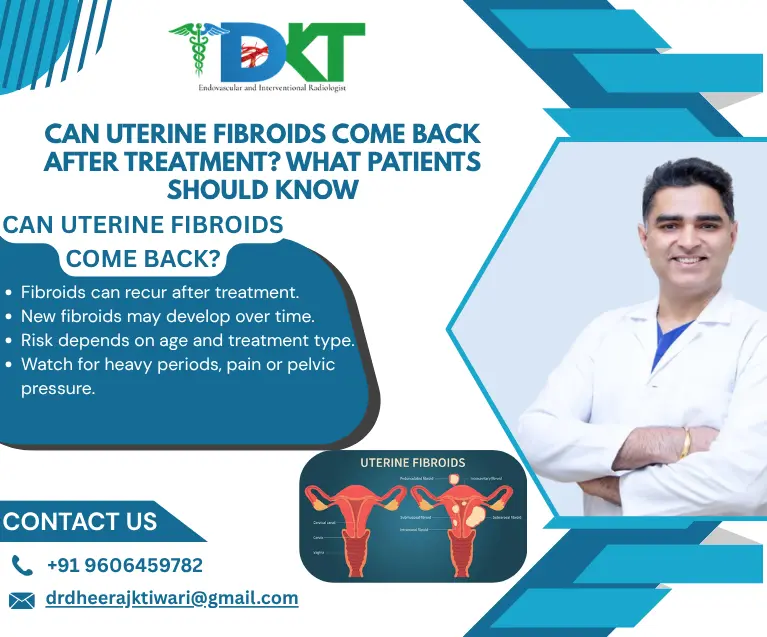
Uterine fibroids are common non-cancerous growths that develop in or around the uterus. For many patients, treatment can significantly reduce symptoms such as heavy menstrual bleeding, pelvic pressure, abdominal discomfort, and frequent urination. However, an important question remains: Can Uterine Fibroids Come Back After Treatment? What Patients Should Know is that recurrence depends greatly on the treatment used, the patient’s age, hormonal environment, and whether new fibroids develop later.
Fibroid Recurrence After Treatment does not always mean that the original fibroid has returned. In some situations, a new uterine fibroid may develop after the treated fibroid has been successfully removed or reduced. Understanding this difference can help patients make informed decisions about treatment and long-term follow-up.
For patients searching for fibroid treatment in Bangalore, consultation with an experienced interventional radiologist can help determine whether a minimally invasive option such as uterine fibroid embolization (UFE) may be appropriate.
Can Uterine Fibroids Come Back After Treatment? What Patients Should Know About Recurrence
Can fibroids return after treatment?
Yes. Can Uterine Fibroids Come Back After Treatment? What Patients Should Know is not a simple yes-or-no question because recurrence varies according to the procedure and individual circumstances.
After treatment, the specific fibroid that was treated may remain controlled, but other fibroids can sometimes develop. Fibroids are influenced by hormones, particularly estrogen and progesterone, so treatment does not necessarily eliminate the underlying tendency to form fibroids.
The likelihood of recurrence also depends on the type of treatment:
- Myomectomy: Removes existing fibroids while preserving the uterus. New fibroids can develop later.
- Uterine Fibroid Embolization: Reduces blood supply to fibroids, causing them to shrink. Treated fibroids generally remain reduced, although new fibroids can develop.
- Hysterectomy: Removes the uterus, so uterine fibroids cannot recur in the uterus afterward.
- Medication: May control bleeding or other symptoms temporarily, but some medications do not permanently eliminate fibroids.
What symptoms may suggest a problem?
Patients should speak with their doctor if symptoms return or become progressively worse after treatment. Possible symptoms include:
- Heavy or prolonged menstrual bleeding
- Pelvic pressure or fullness
- Lower abdominal discomfort
- Painful periods
- Frequent urination
- Constipation or bowel pressure
- Abdominal enlargement
- Fatigue related to iron-deficiency anemia
Symptoms alone cannot confirm Fibroid Recurrence After Treatment. A new evaluation is usually needed to determine whether symptoms are caused by fibroids or another gynecological condition.
Why can a uterine fibroid develop again?
Fibroids are hormone-responsive growths. If the uterus remains present and the patient continues to have menstrual cycles, there can be a possibility of developing additional fibroids.
Age is another important consideration. Patients treated at a younger age may have more years during which new fibroids can potentially develop.
Therefore, Can Uterine Fibroids Come Back After Treatment? What Patients Should Know should be considered in the context of the patient’s age, treatment type, number and size of fibroids, symptoms, and future reproductive plans.
Can Uterine Fibroids Come Back After Treatment? What Patients Should Know About Diagnosis and Treatment
How is recurrence diagnosed?
If symptoms return, the doctor may review the patient’s previous treatment records and perform a clinical assessment. Imaging is often important because symptoms cannot determine whether a fibroid has returned or whether another condition is responsible.
Depending on the situation, evaluation may include:
- Pelvic ultrasound
- MRI of the pelvis
- Blood tests when heavy bleeding has caused anemia
- Review of menstrual and symptom history
- Assessment of previous fibroid treatment
MRI can provide detailed information about the number, location, size, and characteristics of fibroids and may be particularly useful when treatment planning is required.
What treatment options are available?
Treatment depends on the patient’s symptoms, fibroid characteristics, age, overall health, and reproductive goals. There is no single treatment that is appropriate for every patient.
Uterine Fibroid Embolization (UFE) is one minimally invasive option. During UFE, an interventional radiologist uses image guidance to place a catheter into the blood vessels supplying the uterus and delivers small embolic particles to reduce blood flow to the fibroids. Reduced blood supply causes the fibroids to shrink over time.
Other options can include:
- Medication for symptom management
- Myomectomy
- Repeat minimally invasive treatment in selected patients
- Hysterectomy when clinically appropriate
- Observation for small or asymptomatic fibroids
UFE versus surgery
For selected patients, UFE can provide an alternative to surgical removal of individual fibroids.
| Factor | Uterine Fibroid Embolization | Myomectomy |
| Approach | Minimally invasive | Surgical |
| Fibroids | Treats multiple fibroids simultaneously | Removes selected fibroids |
| Uterus | Preserved | Preserved |
| Incision | Usually no large surgical incision | Surgical incisions required |
| Recovery | Generally shorter than major surgery | Depends on surgical approach |
| Suitability | Depends on fibroid anatomy and patient factors | Depends on number, size and location |
This comparison does not mean UFE is automatically better than surgery. The appropriate treatment should be determined after an individual medical assessment.
What happens after UFE?
After uterine fibroid embolization, the fibroids gradually shrink rather than disappearing immediately. Some patients experience cramping, pelvic discomfort, tiredness, nausea, or low-grade fever temporarily after the procedure.
Recovery varies from patient to patient. Many people can return to routine activities relatively quickly, but the exact recovery period depends on the individual’s response and the nature of the procedure.
Follow-up appointments and imaging may be recommended to assess the response to treatment.
Can Uterine Fibroids Come Back After Treatment? What Patients Should Know is particularly relevant during follow-up because changes in symptoms do not always indicate treatment failure. A follow-up assessment can distinguish expected post-treatment changes from persistent or newly developed fibroids.
Can Uterine Fibroids Come Back After Treatment? What Patients Should Know About Long-Term Management
Does recurrence mean the previous treatment failed?
Not necessarily. Fibroid Recurrence After Treatment can mean several different things.
A treated fibroid may not have responded as expected, a residual fibroid may remain, or an entirely new fibroid may have developed. These situations require different approaches.
For this reason, patients should not assume that returning symptoms automatically mean the original treatment was unsuccessful.
Can recurrence be prevented?
There is no guaranteed method for preventing every new fibroid from developing. However, appropriate follow-up can help identify changes early.
Patients should:
- Attend recommended follow-up appointments
- Report persistent or returning symptoms
- Follow treatment and medication instructions
- Discuss heavy menstrual bleeding with their doctor
- Seek evaluation when symptoms affect daily activities
- Keep previous imaging and treatment records available
Healthy lifestyle measures are generally beneficial for overall health, but they should not be presented as a guaranteed way to prevent fibroids.
What should patients know about treatment in Bangalore?
Patients looking for uterine fibroid treatment in Bangalore may have access to both surgical and minimally invasive approaches. An interventional radiologist can assess whether UFE is suitable based on imaging findings and the patient’s clinical situation.
For patients considering treatment near me, the most useful first step is not choosing a procedure based solely on online information. A specialist assessment can determine whether embolization, surgery, medication, observation, or another approach is more appropriate.
Can Uterine Fibroids Come Back After Treatment? What Patients Should Know is ultimately about individualized follow-up. The possibility of new fibroids does not mean treatment cannot provide lasting symptom relief.
Can Uterine Fibroids Come Back After Treatment? What Patients Should Know — FAQs
1. Can uterine fibroids come back after treatment?
Yes. New fibroids can develop after some treatments, particularly when the uterus remains in place. However, recurrence varies significantly between patients and treatment types.
2. Can the same fibroid grow again after embolization?
UFE significantly reduces blood flow to the treated fibroid, causing it to shrink. If symptoms return, imaging is needed to determine whether the treated fibroid has responded appropriately or whether another fibroid is responsible.
3. Is uterine fibroid embolization permanent?
UFE is intended to provide long-term control of treated fibroids, but it cannot guarantee that new fibroids will never develop in the future.
4. Is surgery better than UFE for recurrent fibroids?
Not necessarily. The best treatment depends on fibroid size, location, number, symptoms, previous treatment, health status, and reproductive plans. A specialist should evaluate these factors before recommending treatment.
5. How are recurrent fibroids diagnosed?
A doctor may use symptom assessment, physical examination, ultrasound, MRI, and other investigations when necessary. Imaging helps determine the location and characteristics of fibroids.
6. How long does it take for fibroids to shrink after UFE?
Fibroids generally shrink gradually after embolization rather than immediately. The degree and speed of shrinkage vary among patients, and follow-up imaging can help assess treatment response.
7. Can fibroids return after a myomectomy?
Yes. Myomectomy removes existing fibroids, but it does not eliminate the possibility of developing new fibroids later.
8. Can fibroids return after hysterectomy?
When the uterus is completely removed, uterine fibroids cannot recur in the uterus. However, hysterectomy is a major surgical procedure and is not appropriate for every patient.
9. When should I see a specialist if symptoms return?
Patients should seek medical evaluation if heavy bleeding, pelvic pressure, pain, urinary symptoms, abdominal enlargement, or other previous fibroid symptoms return or become worse.
Conclusion
Can Uterine Fibroids Come Back After Treatment? What Patients Should Know is an important question for anyone considering or recovering from fibroid treatment. The possibility of new fibroids depends on factors such as the treatment performed, age, hormonal status, fibroid characteristics, and whether the uterus remains present.
Fibroid Recurrence After Treatment does not necessarily mean that the previous procedure failed. New or persistent symptoms should be evaluated with appropriate clinical assessment and imaging before deciding on further treatment.
For patients in Bangalore, Dr. Dheeraj Tiwari – Interventional Radiologist In Bangalore can evaluate whether a minimally invasive treatment such as uterine fibroid embolization may be appropriate based on the patient’s individual condition. Treatment decisions should always be personalized; there is no fixed treatment or fabricated standard price because the overall approach and cost depend on the number, size, location of fibroids, symptoms, investigations, and individual medical requirements.
Book an appointment for an individualized evaluation:
Dr. Dheeraj Tiwari – Interventional Radiologist In Bangalore
📍 Mazumdar Shaw Medical Center, 258/A, Hosur Rd, Bommasandra Industrial Area, Anekal, Bangalore, Karnataka 560099
📧 drdheerajktiwari@gmail.com
📞 096064 59782
If you are experiencing recurrent fibroid symptoms, consult a qualified specialist to understand your diagnosis and the treatment options appropriate for your condition.