
A large thyroid nodule can be concerning, especially when it becomes visible in the neck, causes pressure, or affects swallowing. However, a benign thyroid nodule does not always mean that surgery is the only treatment option. Large benign thyroid Nodules Without surgery can sometimes be managed with minimally invasive treatments such as radiofrequency Ablation (RFA), depending on the nodule’s size, appearance, symptoms, thyroid function, and biopsy results.
Radiofrequency ablation for thyroid nodules uses ultrasound guidance to place a thin electrode into the nodule. Controlled heat is then delivered to the targeted tissue, causing it to shrink gradually over time. The American Thyroid Association recognizes thermal ablation as a non-surgical treatment approach for appropriately selected benign thyroid nodules.
For patients looking for Thyroid Nodule Treatment Without Surgery, RFA may provide an alternative to an operation while preserving the surrounding healthy thyroid tissue.
Understanding Large Benign Thyroid Nodules Without Surgery
Thyroid nodules are very common, and most are benign. Many small benign nodules do not require active treatment and can simply be monitored with ultrasound. Treatment may become appropriate when a nodule grows substantially or causes symptoms or cosmetic concerns.
Symptoms of a Large Thyroid Nodule
A benign thyroid nodule may remain unnoticed for years. When it becomes large, possible symptoms include:
- A visible lump or swelling in the lower neck
- Neck pressure or discomfort
- Difficulty swallowing
- A sensation of something pressing against the throat
- Difficulty breathing when the nodule is very large
- Hoarseness or voice changes
- Cosmetic concerns because of a visible neck swelling
- Discomfort while wearing tight collars
- Anxiety related to progressive enlargement
Not every large nodule requires treatment. The decision depends on the individual patient and clinical findings.
Causes of Thyroid Nodules
Thyroid nodules can develop for several reasons. Common contributing factors include changes in thyroid tissue, benign overgrowth of thyroid cells, thyroid cysts, inflammation, iodine-related factors, and certain thyroid disorders.
Most thyroid nodules are not cancerous. Nevertheless, the first priority is establishing that a nodule is genuinely benign before considering an ablative treatment. The American Thyroid Association notes that most thyroid nodules are benign, while a smaller proportion are cancerous.
Diagnosis Before Non-Surgical Treatment
A proper evaluation usually involves:
- Clinical examination – The doctor evaluates the neck and symptoms.
- Thyroid ultrasound – Ultrasound assesses the nodule’s size, composition, margins, vascularity and other characteristics.
- Thyroid function tests – Blood tests such as TSH help determine whether the thyroid is functioning normally.
- Fine-needle aspiration biopsy – When indicated, a biopsy helps establish whether the nodule is benign.
- Treatment planning – The specialist considers symptoms, nodule characteristics, location and patient preferences.
A diagnosis of benign disease is particularly important before proceeding with RFA. Appropriate patient selection and technical expertise are emphasized in professional guidance on thyroid ablation.
Large Benign Thyroid Nodules Without Surgery: Radiofrequency Ablation
For appropriately selected patients, Large Benign Thyroid Nodules Without Surgery may be possible through Radiofrequency Ablation for Thyroid Nodules.
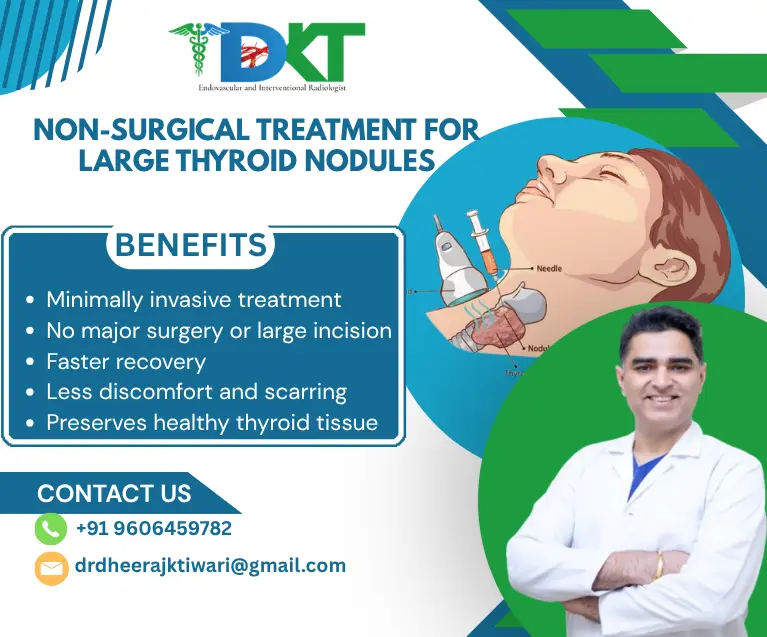
RFA is a minimally invasive procedure rather than conventional surgery. Instead of making a surgical incision to remove the thyroid or nodule, an interventional radiologist uses ultrasound guidance to position a specialized electrode inside the target nodule.
How Radiofrequency Ablation for Thyroid Nodules Works
The procedure generally involves these steps:
- Ultrasound mapping:
The thyroid and nodule are examined using ultrasound to determine the safest treatment pathway. - Local anesthesia:
The treatment area is numbed. RFA is generally performed without the need for general anesthesia. - Electrode placement:
A thin RFA electrode is carefully introduced into the nodule under continuous ultrasound guidance. - Controlled energy delivery:
Radiofrequency energy produces heat within targeted portions of the nodule. This causes thermal destruction of the treated tissue. - Gradual shrinkage:
The treated tissue is gradually absorbed or reduced by the body, resulting in progressive reduction in nodule volume.
RFA does not necessarily make the nodule disappear immediately. The reduction occurs progressively during follow-up. Research summarized by the American Thyroid Association has demonstrated substantial long-term volume reduction following RFA in appropriately selected benign nodules.
Who May Be Suitable for RFA?
Thyroid Nodule Treatment Without Surgery may be considered when a benign nodule:
- Is large or progressively enlarging
- Causes pressure or swallowing symptoms
- Creates cosmetic concerns
- Has been adequately evaluated as benign
- Is technically suitable for ablation
- Is being considered for treatment by an appropriately trained specialist
Not every thyroid nodule is suitable for RFA. A specialist must assess the individual anatomy and clinical situation before recommending treatment.
Benefits of RFA
Potential advantages of Large Benign Thyroid Nodules Without Surgery with RFA include:
- No conventional surgical incision
- No large neck scar
- Local rather than general anesthesia in many cases
- Preservation of much of the surrounding thyroid tissue
- Shorter recovery compared with conventional surgery
- Gradual reduction in nodule size
- Improvement in pressure or cosmetic symptoms in appropriate patients
Clinical studies have shown that Radiofrequency Ablation can significantly reduce the size of benign thyroid nodules over time. Many patients experience improvement in pressure-related or cosmetic symptoms as the treated nodule gradually shrinks. The treatment is minimally invasive, but potential risks such as pain, swelling, bleeding, or voice changes should be discussed with the treating specialist before the procedure.
These results do not mean every patient will experience the same outcome. Nodule size, composition, location, blood supply and other factors can affect response.
Large Benign Thyroid Nodules Without Surgery: Procedure, Recovery and Comparison
Understanding what happens before, during and after treatment can help patients make an informed decision.
Recovery After Radiofrequency Ablation
Recovery after RFA is generally quicker than after conventional thyroid surgery. Some patients may experience temporary neck discomfort, swelling, tenderness or a sensation of tightness following treatment.
Patients are usually advised to follow their treating specialist’s instructions regarding activity, medications and follow-up.
Ultrasound follow-up is important because the treated nodule continues to shrink over time. Some patients may require additional treatment depending on the initial nodule size, residual viable tissue, symptoms or regrowth. The 2026 American Thyroid Association summary also notes that multiple RFA treatments may sometimes be required.
RFA Compared With Thyroid Surgery
| Feature | Radiofrequency Ablation | Conventional Surgery |
| Approach | Minimally invasive | Surgical |
| Incision | No conventional surgical incision | Neck incision |
| Anesthesia | Often local anesthesia | Usually general anesthesia |
| Thyroid tissue | Aims to preserve functioning thyroid tissue | Part or all of thyroid may be removed |
| Scar | No typical surgical scar | Surgical neck scar |
| Recovery | Generally shorter | Generally longer |
| Nodule reduction | Gradual | Immediate removal |
| Follow-up | Ultrasound monitoring required | Postoperative monitoring required |
Surgery remains an important treatment when a nodule is suspicious or malignant, when anatomy makes ablation unsuitable, or when there are other clinical reasons for surgical management. RFA should therefore be viewed as an option for carefully selected benign nodules rather than a replacement for surgery in every situation.
Risks and Limitations
Although RFA is minimally invasive, it is still a medical procedure and is not completely risk-free. Potential complications may include pain, bleeding, infection, skin injury, changes in voice due to nerve irritation or injury, and incomplete treatment.
There is also a possibility of nodule regrowth or the need for repeat treatment. Long-term follow-up research has documented that some patients eventually required additional RFA or surgery.
Why Choose an Experienced Interventional Radiologist?
Thyroid RFA requires detailed knowledge of thyroid anatomy, ultrasound guidance and thermal ablation techniques. Structures such as the recurrent laryngeal nerve, trachea, esophagus and blood vessels need to be considered during treatment.
Dr. Dheeraj Tiwari – Interventional Radiologist in Bangalore provides minimally invasive image-guided interventional care. His practice focuses on procedures performed using image guidance, and thyroid nodule ablation can be discussed as part of an individualized evaluation where clinically appropriate.
Dr. Dheeraj Tiwari – Interventional Radiologist In Bangalore
For patients considering Large Benign Thyroid Nodules Without Surgery, an individual consultation can help determine whether RFA is appropriate based on ultrasound findings, biopsy results, thyroid function and symptoms.
FAQs About Large Benign Thyroid Nodules Without Surgery
1. Can a large benign thyroid nodule be treated without surgery?
Yes. Selected benign thyroid nodules can be treated with minimally invasive techniques such as RFA. Suitability depends on the nodule and the patient’s medical evaluation.
2. What is Radiofrequency Ablation for Thyroid Nodules?
Radiofrequency Ablation for Thyroid Nodules is a minimally invasive treatment in which a thin electrode delivers controlled heat into a benign thyroid nodule under ultrasound guidance.
3. Is RFA painful?
Local anesthesia is generally used to numb the treatment area. Some patients may experience pressure, warmth or temporary discomfort during or after the procedure.
4. Will the thyroid nodule disappear immediately after RFA?
No. RFA treats the targeted tissue, but the nodule generally shrinks gradually. Follow-up ultrasound is used to monitor the reduction.
5. Is RFA better than surgery?
Neither treatment is universally better. RFA may be attractive for selected benign nodules when the goal is to reduce the nodule without conventional surgery. Surgery remains appropriate in many other situations.
6. Can RFA preserve thyroid function?
RFA targets the nodule while aiming to preserve surrounding thyroid tissue. This may reduce the likelihood of thyroid hormone dependence compared with procedures that remove substantial amounts of thyroid tissue, although individual outcomes vary.
7. Can a thyroid nodule grow again after RFA?
Yes. Regrowth can occur in some patients, which is why long-term ultrasound monitoring is important. Some patients may need repeat treatment.
8. How long does recovery take after RFA?
Recovery is generally quicker than conventional thyroid surgery, but the exact recovery period varies. Your specialist will provide individualized instructions based on the procedure and your health.
9. Does every benign thyroid nodule need treatment?
No. Many benign nodules can simply be monitored. Treatment is generally considered when a nodule causes symptoms, cosmetic concerns, significant growth or other clinical problems.
10. Where can I get evaluated for thyroid nodule RFA in Bangalore?
Patients in Bangalore considering Large Benign Thyroid Nodules Without Surgery can consult Dr. Dheeraj Tiwari, Interventional Radiologist in Bangalore, for assessment and discussion of minimally invasive treatment options.
Conclusion
Large Benign Thyroid Nodules Without Surgery is an increasingly relevant treatment approach for patients who want to manage symptomatic or cosmetically concerning benign nodules without conventional thyroid surgery. Radiofrequency Ablation for Thyroid Nodules can reduce nodule volume while using a minimally invasive, ultrasound-guided technique.
However, RFA is not appropriate for every patient. Proper ultrasound evaluation, thyroid testing and appropriate confirmation of benign disease are essential before treatment. Long-term follow-up is also important because the nodule shrinks gradually and, in some cases, regrowth or repeat treatment may occur.
If you are searching for Large Benign Thyroid Nodules Without Surgery, speak with an experienced interventional radiologist to understand whether RFA is suitable for your individual condition.
Book a consultation with Dr. Dheeraj Tiwari – Interventional Radiologist in Bangalore to discuss your thyroid nodule, review your diagnostic reports and explore appropriate minimally invasive treatment options. Early specialist evaluation can help you understand whether Thyroid Nodule Treatment Without Surgery is a suitable choice for you.